kết quả từ 1 tới 11 trên 11

Ðề tài: Cảm Nhận Của Tôi Về Người Do Thái

  1. #1

    Question Cảm Nhận Của Tôi Về Người Do Thái

    Lần đầu tiên tôi thấy 1 người Do Thái trong 1 chuyến đi chơi dã ngoại trên một chiếc xe , tôi rất là ghét họ .

    Tôi không có thiện cảm , vì họ ăn mặc không giống ai , tự nhiên đội cái mũ len trên đầu . :straight_face:


    Người do thái đó làm việc không giống ai , đó là đọc sách chăm chú trên một chiếc xe .

    Trong khi những người khác thì ăn uống, chờ đợi và trò truyện.

    Tôi có ác cảm với người do thái vì tôi nghĩ rằng họ là Bọn Bán Chúa.

    Những Kẻ Giết Chúa.

    Một Giống Dân Phản Bội Chúa !!!

  2. #2

    Mặc định

    Sau đó , tôi tìm hiểu về trùm sò Đức Quốc Xã Hít Lơ , Hitler

    tôi thấy rằng Hitle là một người tài năng , hiền lành , yêu nghệ thuật và ăn chay

    Hitler đã làm cho kinh tế nước Đức phát triển sau WW I

    kể từ đó tôi có cảm tình với Hít Lơ , Hitler

    SVCZ YouTube Player
    ERROR: If you can see this, then YouTube is down or you don't have Flash installed.

  3. #3

    Mặc định

    Sau khi đọc và tìm hiểu về người Do Thái qua các trang báo tại Việt Nam.

    Tôi luôn luôn cho rằng người Do Thái là một Chủng Tộc.

    http://nguyentandung.org/tai-sao-ngu...hong-minh.html

    Những tên tuổi lớn của thế kỷ 20 có thể kể đến như bộ óc thế kỷ Albert Einstein, Sigmund Freud, Otto Frisch, .v.v. đều là người Do Thái. Dù không phải là chủng tộc lớn, vậy nhưng không một nhóm chủng tộc nào có thể sánh được với người Do Thái về khả năng và thành tích vượt trội. Kết hợp với những tính cách di truyền của người Do Thái như tham vọng, ham hiểu biết, tích cực, trí tưởng tượng phong phú, bền bỉ, sự thông minh của người Do Thái thực sự đã là đòn bẩy khiến người Do Thái đứng đầu trong tất cả các lĩnh vực cuộc sống.

  4. #4

    Mặc định

    Nhưng khi tôi tìm hiểu về người do thái qua các trang tiếng Anh thuộc các tổ chức Do Thái.

    Tôi nhận ra rằng tôi đã sai.

    Do Thái rốt cuộc chỉ là một tôn giáo ...

  5. #5

    Mặc định

    Các tôn giáo thì từ xưa tới nay luôn có xung đột , không nhỏ thì lớn , không lớn thì nhỏ

    thôi mặc kệ .

  6. #6

    Mặc định

    Trích dẫn Nguyên văn bởi nothing0k Xem Bài Gởi
    Nhưng khi tôi tìm hiểu về người do thái qua các trang tiếng Anh thuộc các tổ chức Do Thái.

    Tôi nhận ra rằng tôi đã sai.

    Do Thái rốt cuộc chỉ là một tôn giáo ...
    Hèng chi mỗi lần tui dô phòng Đạo Thiên Chúa đọc mấy bài đăng của bạn mà tui hổng hiểu gì hết trơn :surprise:

    Bác admin Love_Tamlinh ơi, bác làm ơn xây một cái phòng "Đạo Do Thái" riêng cho bạn nothing0k để người đọc khỏi bị lẫn lộn và loãng ý truyền đạt của bạn nothing0k. Xin đa tạ ông admin trước heng!
    "Toma, vì con thấy Thầy nên con đã tin. Phúc cho những ai không thấy mà tin!" (Ga 20,24-29) :big_hug:

  7. #7

    Mặc định

    Xin hỏi bạn nothingok là nguồn gốc 2 chữ "DO THÁI" so với "ISRAEN"? Thân chào!

  8. #8

    Mặc định

    Trích dẫn Nguyên văn bởi Sesônglai Xem Bài Gởi
    Xin hỏi bạn nothingok là nguồn gốc 2 chữ "DO THÁI" so với "ISRAEN"? Thân chào!
    Viết là Israel không phải là IsraEN

    http://www.jewfaq.org/whoisjew.htm

    Origins of the Words "Jew" and "Judaism"

    The original name for the people we now call Jews was Hebrews. The word "Hebrew" (in Hebrew, "Ivri") is first used in the Torah to describe Abraham (Gen. 14:13). The word is apparently derived from the name Eber, one of Abraham's ancestors. Another tradition teaches that the word comes from the word "eyver," which means "the other side," referring to the fact that Abraham came from the other side of the Euphrates, or referring to the fact Abraham was separated from the other nations morally and spiritually.

    Another name used for the people is Children of Israel or Israelites, which refers to the fact that the people are descendants of Jacob, who was also called Israel.

    The word "Jew" (in Hebrew, "Yehudi") is derived from the name Judah, which was the name of one of Jacob's twelve sons. Judah was the ancestor of one of the tribes of Israel, which was named after him. Likewise, the word Judaism literally means "Judah-ism," that is, the religion of the Yehudim. Other sources, however, say that the word "Yehudim" means "People of G-d," because the first three letters of "Yehudah" are the same as the first three letters of G-d's four-letter name.

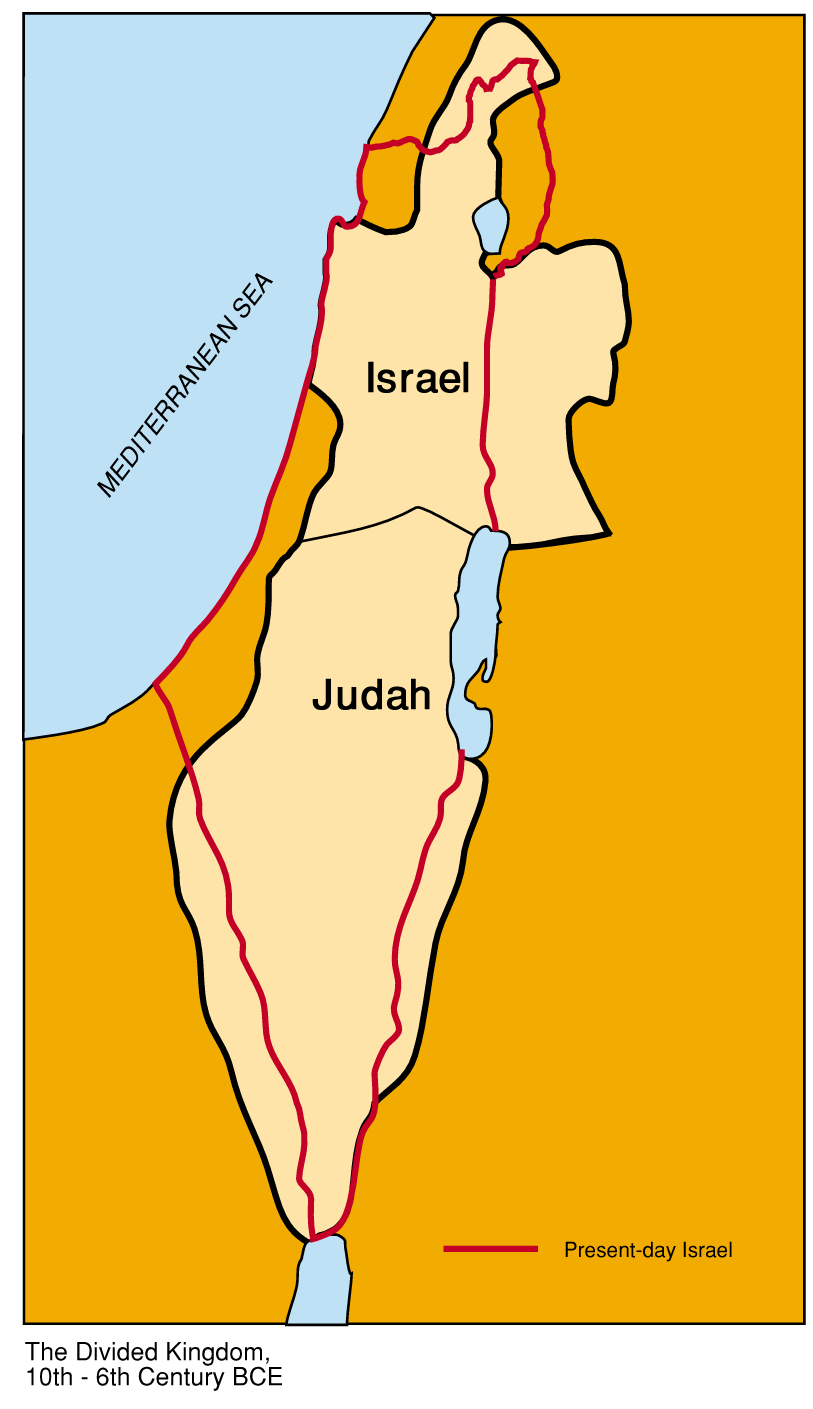
    Originally, the term Yehudi referred specifically to members of the tribe of Judah, as distinguished from the other tribes of Israel. However, after the death of King Solomon, the nation of Israel was split into two kingdoms: the kingdom of Judah and the kingdom of Israel (I Kings 12; II Chronicles 10). After that time, the word Yehudi could properly be used to describe anyone from the kingdom of Judah, which included the tribes of Judah, Benjamin and Levi, as well as scattered settlements from other tribes. The most obvious biblical example of this usage is in Esther 2:5, where Mordecai is referred to as both a Yehudi and a member of the tribe of Benjamin.

    In the 6th century B.C.E., the kingdom of Israel was conquered by Assyria and the ten tribes were exiled from the land (II Kings 17), leaving only the tribes in the kingdom of Judah remaining to carry on Abraham's heritage. These people of the kingdom of Judah were generally known to themselves and to other nations as Yehudim (Jews), and that name continues to be used today.

    In common speech, the word "Jew" is used to refer to all of the physical and spiritual descendants of Jacob/Israel, as well as to the patriarchs Abraham and Isaac and their wives, and the word "Judaism" is used to refer to their beliefs. Technically, this usage is inaccurate, just as it is technically inaccurate to use the word "Indian" to refer to the original inhabitants of the Americas. However, this technically inaccurate usage is common both within the Jewish community and outside of it, and is therefore used throughout this site.

  9. #9

    Mặc định

    ...Xin lỗi mình ko rành English. Mình phỏng đoán "DO THÁI" là từ HÁN VIỆT. Ko rõ tiếng Hán gọi ISRAEL LÀ GÌ HÉN? Có 1 thời Israel chia đôi nam bắc, miền bắc vẫn giữ tên gọi Israel, nhưng thờ thần của mấy bà vợ dân ngoại. Còn miền nam có tên là GIUĐÊA hay GIUĐA ko rõ lắm! GIUDA và DO THÁI, xem có vẻ liên quan mật thiết nhỉ?

  10. #10

    Mặc định

    http://en.wikipedia.org/wiki/History...rael_and_Judah

    Israel and Judah were related Iron Age kingdoms of the ancient Levant. The Kingdom of Israel emerged as an important local power by the 9th century BCE before falling to the Neo-Assyrian Empire in 722 BCE. Israel's southern neighbor, the Kingdom of Judah, emerged in the 8th century[1] and enjoyed a period of prosperity as a client-state of first Assyria and then Babylon before a revolt against the Neo-Babylonian Empire led to its destruction in 586 BCE. Following the fall of Babylon to the Persian king Cyrus the Great in 539 BCE, some Judean exiles returned to Jerusalem, inaugurating the formative period in the development of a distinctive Judahite identity in the Persian province of Yehud. Yehud was absorbed into the subsequent Hellenistic kingdoms that followed the conquests of Alexander the Great, but in the 2nd century BCE the Judaeans revolted against the Hellenist Seleucid Empire and created the Hasmonean kingdom. This, the last nominally independent Judean kingdom, came to an end in 63 BCE with its conquest by Pompey of Rome. With the installation of client kingdoms under the Herodian Dynasty, the Kingdom of Israel was wracked by civil disturbances which culminated in the Jewish Revolt, the destruction of the Temple, the emergence of rabbinical Judaism and Christianity. It then became a part of the Roman (and later Byzantine) Empire until the Arab conquests of the 7th century CE.

  11. #11

    Mặc định

    http://www.jewishvirtuallibrary.org/...Kingdoms1.html

    Ancient Jewish History:
    The Two Kingdoms
    (c.920 BCE - 597 BCE)

    The experiment with the opulence and power of the great eastern kingdoms had ended in disaster for Israel. King Solomon created the wealthiest and most powerful central government the Hebrews would ever see, but he did so at an impossibly high cost. Land was given away to pay for his extravagances and people were sent into forced labor into Tyre in the north. When Solomon died, between 926 and 922 BCE, the ten northern tribes refused to submit to his son, Rehoboam, and revolted.

    From this point on, there would be two kingdoms of Hebrews: in the north - Israel, and in the south - Judah. The Israelites formed their capital in the city of Samaria, and the Judaeans kept their capital in Jerusalem. These kingdoms remained separate states for over two hundred years.

    The history of the both kingdoms is a litany of ineffective, disobedient, and corrupt kings. When the Hebrews had first asked for a king, in the book of Judges, they were told that only God was their king. When they approached Samuel the Prophet, he told them the desire for a king was an act of disobedience and that they would pay dearly if they established a monarchy. The history told in the Hebrew book, Kings, bears out Samuel's warning.

    The Hebrew empire eventually collapses, Moab successfully revolts against Judah, and Ammon successfully secedes from Israel. Within a century of Solomon's death, the kingdoms of Israel and Judah were left as tiny little states - no bigger than Connecticut - on the larger map of the Middle East.

    As history proved time and again in the region, tiny states never survived long. Located directly between the Mesopotamian kingdoms in the northeast and powerful Egypt in the southwest, the Hebrew Kingdoms were of the utmost commercial and military importance to all these warring powers. Being small was a liability.

    The Conquest of Israel
    In 722 BC, the Assyrians conquered Israel. The Assyrians were aggressive and effective; the history of their dominance over the Middle East is a history of constant warfare. In order to assure that conquered territories would remain pacified, the Assyrians would force many of the native inhabitants to relocate to other parts of their empire. They almost always chose the upper and more powerful classes, for they had no reason to fear the general mass of a population. They would then send Assyrians to relocate in the conquered territory.

    When they conquered Israel, they forced the ten tribes to scatter throughout their empire. For all practical purposes, you might consider this a proto-Diaspora ("diaspora"="scattering"), except that these Israelites disappear from history permanently; they are called "the ten lost tribes of Israel." Why this happened is difficult to assess. The Assyrians did not settle the Israelites in one place, but scattered them in small populations all over the Middle East. When the Babylonians later conquered Judah, they, too, relocate a massive amount of the population. However, they move that population to a single location so that the Jews can set up a separate community and still retain their religion and identity. The Israelites deported by the Assyrians, however, do not live in separate communities and soon drop their Yahweh religion and their Hebrew names and identities.

    The Samaritans
    One other consequence of the Assyrian invasion of Israel involved the settling of Israel by Assyrians. This group settled in the capital of Israel, Samaria, and they took with them Assyrian gods and cultic practices. But the people of the Middle East were above everything else highly superstitious. Even the Hebrews didn't necessarily deny the existence or power of other peoples' gods—just in case. Conquering peoples constantly feared that the local gods would wreak vengeance on them. Therefore, they would adopt the local god or gods into their religion and cultic practices.

    Within a short time, the Assyrians in Samaria were worshipping Yahweh as well as their own gods; within a couple centuries, they would be worshipping Yahweh exclusively. Thus was formed the only major schism in the Yahweh religion: the schism between the Jews and the Samaritans. The Samaritans, who were Assyrian and therefore non-Hebrew, adopted almost all of the Hebrew Torah and cultic practices; unlike the Jews, however, they believed that they could sacrifice to God outside of the temple in Jerusalem. The Jews frowned on the Samaritans, denying that a non-Hebrew had any right to be included among the chosen people and angered that the Samaritans would dare to sacrifice to Yahweh outside of Jerusalem. The Samaritan schism played a major role in the rhetoric of Jesus of Nazareth; and there are still Samaritans alive today around the city of Samaria.

    The Conquest of Judah
    "There but for the grace of god go I." Certainly, the conquest of Israel scared the people and monarchs of Judah. They barely escaped the Assyrian menace, but Judah would be conquered by the Chaldeans about a century later. In 701, the Assyrian Sennacherib would gain territory from Judah, and the Jews would have suffered the same fate as the Israelites. But by 625 BC, the Babylonians, under Nabopolassar, would reassert control over Mesopotamia, and the Jewish king Josiah aggressively sought to extend his territory in the power vacuum that resulted. But Judah soon fell victim to the power struggles between Assyrians, Babylonians, and Egyptians. When Josiah's son, Jehoahaz, became king, the king of Egypt, Necho (put into power by the Assyrians), rushed into Judah and deposed him, and Judah became a tribute state of Egypt. When the Babylonians defeated the Egyptians in 605 BC, then Judah became a tribute state to Babylon. But when the Babylonians suffered a defeat in 601 BC, the king of Judah, Jehoiakim, defected to the Egyptians. So the Babylonian king, Nebuchadnezzar, raised an expedition to punish Judah in 597 BC. The new king of Judah, Jehoiachin, handed the city of Jerusalem over to Nebuchadnezzar, who then appointed a new king over Judah, Zedekiah. In line with Mesopotamian practice, Nebuchadnezzar deported around 10,000 Jews to his capital in Babylon; all the deportees were drawn from professionals, the wealthy, and craftsmen. Ordinary people were allowed to stay in Judah. This deportation was the beginning of the Exile.

    The story should have ended there. However, Zedekiah defected from the Babylonians one more time. Nebuchadnezzar responded with another expedition in 588 and conquered Jerusalem in 586. Nebuchadnezzar caught Zedekiah and forced him to watch the murder of his sons; then he blinded him and deported him to Babylon. Again, Nebuchadnezzr deported the prominent citizens, but the number was far smaller than in 597: somewhere between 832 and 1577 people were deported.

    The Hebrew kingdom, started with such promise and glory by David, was now at an end. It would never appear again, except for a brief time in the second century BC, and to the Jews forced to relocate and the Jews left to scratch out a living in their once proud kingdom, it seemed as if no Jewish nation would ever exist again. It also seemed as if the special bond that Yahweh had promised to the Hebrews, the covenant that the Hebrews would serve a special place in history, had been broken and forgotten by their god. This period of confusion and despair, a community together but homeless in the streets of Babylon, makes up one of the most significant historical periods in Jewish history: the Exile.


Thread Information

Users Browsing this Thread

There are currently 1 users browsing this thread. (0 members and 1 guests)

Similar Threads

  1. Trả lời: 112
    Bài mới gởi: 21-05-2019, 08:28 AM
  2. Chuyện ma có thật: Tai nạn đáng ngờ (tự nhặt của mình)
    By hacbachvothuong in forum Chuyện Ma, Quỉ
    Trả lời: 544
    Bài mới gởi: 29-08-2017, 05:18 AM
  3. Hành trình một linh hồn
    By TuTam in forum Thông thiên học
    Trả lời: 33
    Bài mới gởi: 18-10-2013, 02:27 PM
  4. SỐNG TRONG TỪNG SÁT-NA !
    By Dieudiem in forum Đạo Phật
    Trả lời: 5
    Bài mới gởi: 01-12-2012, 07:35 PM
  5. Chúa Giê su chữa người bị phong cùi
    By minhthai in forum Đạo Thiên Chúa
    Trả lời: 16
    Bài mới gởi: 17-04-2012, 07:36 AM

Bookmarks

Quyền Hạn Của Bạn

  • You may not post new threads
  • You may not post replies
  • You may not post attachments
  • You may not edit your posts
  •